
Bucharest is often described through contrasts: elegant Belle Époque villas standing beside massive concrete blocks, leafy boulevards interrupted by monumental axes of power, and a lively contemporary culture shaped by memories that are still raw. To truly understand the Romanian capital, one must engage with the decades when communist ideology reshaped not only politics but the very structure of the city. private guided tours of communist era Bucharest with a local guide offer an immersive way to decode this complex urban narrative, revealing how power, fear, ambition, and everyday resilience became embedded in streets, buildings, and neighborhoods.
A communist-era history tour of Bucharest is not an abstract academic exercise. It is an encounter with a past that ended only a generation ago and whose traces remain unavoidable. These tours explore how the city was transformed into a stage for ideology, how citizens adapted to standardized living, and how the violent collapse of the regime still echoes in public memory. With the insight of a knowledgeable local guide, visitors move beyond surface impressions and begin to read Bucharest as a living document of the twentieth century.
Bucharest Before and After Communism: A City Rewritten
Before the communist takeover after World War II, Bucharest cultivated an identity often referred to as “Little Paris.” Wide avenues, French-inspired architecture, and a vibrant cultural life defined the city. This character was not erased overnight, but from the late 1940s onward it was steadily overwritten. A tour focused on this period explains how nationalization, centralized planning, and ideological control altered both ownership and aesthetics, gradually replacing diversity with uniformity.
Communist tours of Bucharest with a local guide usually begin by contextualizing this rupture. Guides explain how private property was confiscated, historic districts were neglected or demolished, and architectural expression was redirected toward socialist realism and later brutalist modernism. Walking through the city, visitors see layers of time compressed into single streets: interwar villas overshadowed by apartment slabs, churches hidden behind concrete screens, and surviving prewar buildings that seem almost accidental. Understanding these contrasts is essential to grasping why Bucharest feels fragmented yet intensely expressive.
Ceaușescu’s Vision and the Architecture of Power
Any serious exploration of communist Bucharest inevitably centers on Nicolae Ceaușescu. Rising to power in 1965, he pursued an increasingly personal and authoritarian vision of socialism, one that used architecture and urban planning as tools of domination. A guided tour explains how his obsession with grandeur culminated in vast construction projects intended to symbolize national strength and absolute control.
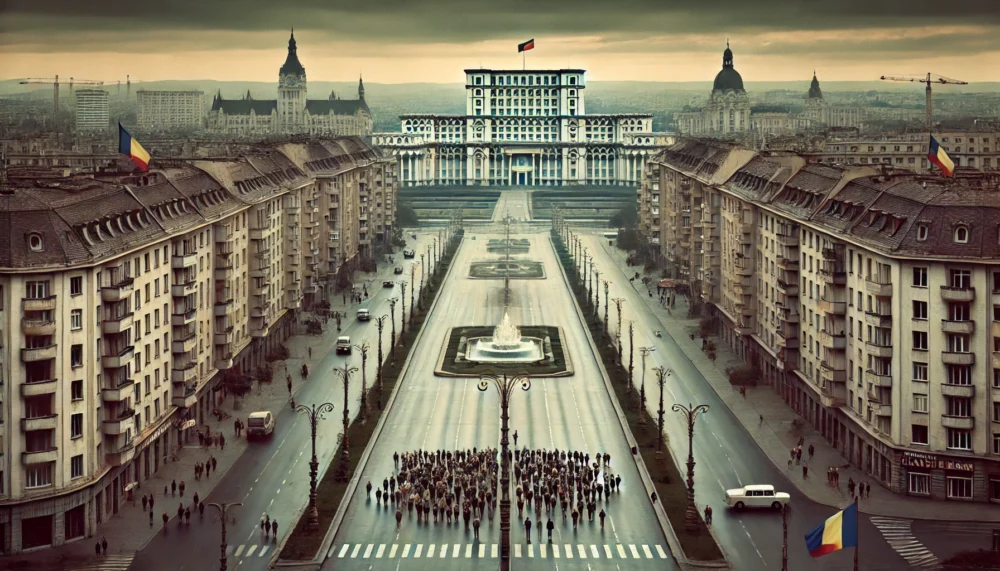
The Palace of the Parliament dominates this narrative. Approaching it on foot is a powerful experience: the scale overwhelms, the symmetry intimidates, and the materials convey excess rather than utility. Local guides provide the historical depth behind this spectacle, describing how entire neighborhoods were demolished, tens of thousands of residents displaced, and immense resources diverted during a period of widespread austerity. Visitors learn that the building was conceived as the ultimate symbol of a “house for the people,” yet its opulence and isolation exposed the regime’s profound disconnect from ordinary life.
Equally revealing is the monumental boulevard leading to it, originally designed for parades and demonstrations of loyalty. Walking this axis with commentary brings attention to the way space was choreographed to produce obedience and awe. Every façade, every proportion, and every visual line was calculated to reinforce the cult of leadership. These insights transform what might appear as simply an oversized street into a lesson in authoritarian urban design.
Everyday Life in the Concrete Neighborhoods
While monumental projects illustrate the ambitions of the regime, the true story of communism in Bucharest unfolds in residential districts. A well-designed tour ventures beyond the city center into areas where millions lived their daily lives. Here, the repetitive silhouettes of apartment blocks reveal another side of the ideology: the promise of equality through standardization.
Local guides explain the logic behind these neighborhoods, often built as self-sufficient units with schools, clinics, and shops integrated into their layout. They describe how families waited years for an apartment allocation, how space was tightly regulated, and how privacy was limited by thin walls and shared courtyards. Yet these tours also emphasize human adaptation. Despite shortages and surveillance, communities formed strong social bonds, children played between buildings, and informal networks helped people cope with scarcity.
Understanding these districts challenges simplistic narratives of oppression by highlighting the complexity of lived experience. Visitors gain insight into how ideology translated into daily routines, from ration cards and power cuts to state-controlled entertainment and education. This balance between hardship and resilience is one of the most compelling aspects of private guided tours of communist era Bucharest with a local guide.
Surveillance, Fear, and the Machinery of Control
Communist rule in Romania relied heavily on surveillance and repression, and a comprehensive tour does not avoid this darker dimension. Sites associated with the secret police, known as the Securitate, offer sobering insight into how control was maintained. Guides explain how informant networks penetrated workplaces, neighborhoods, and even families, creating an atmosphere of pervasive suspicion.
Walking through former interrogation sites or memorial spaces, visitors confront the personal cost of dissent. Stories of imprisonment, forced labor, and exile illustrate the gap between official propaganda and reality. A local guide’s role is crucial here, providing context without sensationalism and connecting individual stories to the broader system. This part of the tour deepens understanding of why fear shaped behavior and why silence became a survival strategy for many.
Revolution and Rupture: December 1989
The communist narrative in Bucharest culminates in the dramatic events of December 1989. A guided visit to Revolution Square brings this moment into sharp focus. Standing in the space where crowds gathered, guides recount how protests escalated, how Ceaușescu’s authority collapsed, and how violence erupted in the heart of the city.
Buildings still bear visible scars from those days, and monuments invite reflection on the cost of transition. Local guides help visitors navigate the contested memories of the revolution, explaining why interpretations vary and why the legacy remains complex. This is not presented as a clean break between past and present, but as a turbulent transformation whose consequences are still unfolding.
Memory, Identity, and Modern Bucharest
The final layer of a communist-era tour addresses how Bucharest remembers and repurposes its past. Former factories become cultural centers, old cinemas host contemporary events, and once-feared spaces are reimagined for public use. Guides point out surviving mosaics, reliefs, and design elements that quietly testify to socialist aesthetics, encouraging visitors to see them not as curiosities but as historical documents.
This perspective helps explain modern Bucharest’s eclectic character. The city’s vibrancy today is inseparable from its recent history, and understanding communism provides a key to interpreting present-day debates about heritage, development, and identity. Visitors interested in deepening this understanding often turn to curated experiences such as the tour offered at https://get-locals.com/tour/bucharest-bucharest-communist-era-history-private-tour-including-spring-palace-visit, which combines historical depth with personal insight.
Why a Local Guide Makes the Difference
Exploring communist Bucharest independently can be overwhelming. The city does not label its past clearly, and many of its most telling sites are easy to overlook. This is why Communist tours of Bucharest with a local guide are especially valuable. A guide not only provides factual knowledge but also cultural interpretation, personal anecdotes, and an understanding of how history is felt rather than merely recorded.
Private guided tours of communist era Bucharest with a local guide allow for questions, dialogue, and tailored pacing, transforming the experience into an intellectual and emotional journey. They reveal a city shaped by ambition and fear, endurance and rupture, and they leave visitors with a nuanced appreciation of how recent history continues to define Bucharest’s urban soul.
Through this exploration of concrete boulevards, standardized neighborhoods, monumental palaces, and scarred squares, travelers come to understand that Bucharest’s communist past is not an isolated chapter. It is the foundation upon which the modern city stands, a labyrinth of memory that rewards those willing to walk it with curiosity and respect.